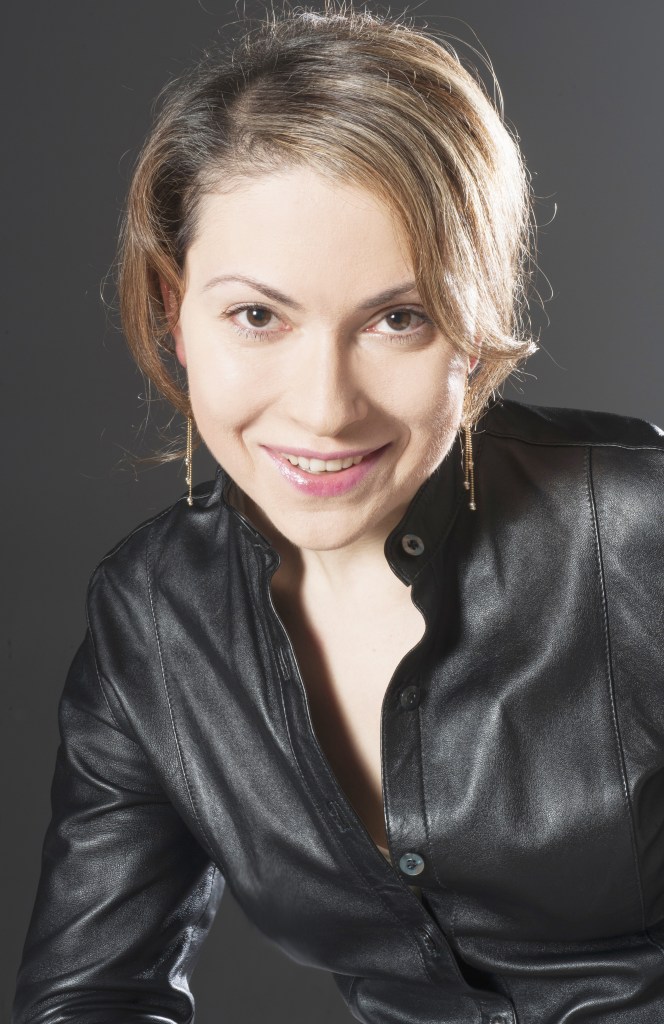
Mariam Sarkissian is a French-Armenian mezzo-soprano and vocal pedagogue whose career bridges rare vocal chamber music, opera stages and cutting-edge cognitive voice research. Born in Moscow and based in Paris since 1996, she first trained as a flautist (1st Prize, CRR Saint‑Maur) before graduating in classical singing from the Schola Cantorum and the École Normale de Musique de Paris, where she received the Master Concertiste diploma.
Celebrated for the warmth and subtlety of her timbre, she has a particular passion for rediscovering overlooked vocal chamber repertoire and has recorded several world premieres. Her interpretations have been praised by the international press and awarded, notably with the Golden Orpheus (Orphée d’Or) of the French Académie du Disque Lyrique. On stage she is equally at home in opera and recital, from travesti roles like Cherubino (Le Nozze di Figaro), Zanetto (Mascagni) and Oreste (La Belle Hélène) to intimate salons and contemporary creations.
A serious car accident became a turning point in her artistic life: forced to rebuild her own voice, as well as her physical and mental form, she returned to the great bel canto masters and, through years of post‑traumatic self‑education, developed an original cognitive approach to vocal technique. This work crystallised as the Sarkissian Method®, a professional vocal technique for singers and speakers centred on her educational concept, the Balance Triangle®, which links creative thought, technical thought and physical execution in a clear mental “coordinate system,” and naturally generates Vocal Cognitive Stimulation® (VCS) in every lesson.
Today Mariam Sarkissian divides her time between performance, teaching and research. At the Atelier Sarkissian in Paris she coaches opera singers, actors, teachers and other professional voice users, as well as children, adult amateurs and neurodivergent students, including people with dys disorders, ADHD and autistic spectrum profiles, using Vocal Cognitive Stimulation® to support vocal health, artistic freedom, cognitive flexibility, mental wellbeing and confidence. With teachers trained in her method, she also leads workshops in nursing homes and long‑term care facilities, as well as medico‑social and therapeutic centres for children and teenagers.
Through her books I think, therefore I sing and In Search of B Flat, masterclasses and collaborations with scientists, she continues to explore how voice, imagination and cognition can mutually enhance each other on stage and in everyday life, notably within the Collegium Musicae (Sorbonne University) and the international “Music, Neuroscience and Therapy” research network, where the Sarkissian Method® and Vocal Cognitive Stimulation® are being studied as innovative tools for pedagogy, rehabilitation and care.
 Mariam SARKISSIAN